
Malga Ciapela: Hiking Marmolada, Cable Cars and the Best of the Dolomites
We arrived at Camping Marmolada in Malga Ciapela — tucked into the Dolomites at the foot of the range’s highest peak — straight from a week at Lake Idro and the temperature drop was instant. A good ten degrees cooler, the kind of relief your lungs actually thank you for. From the moment we pulled in it felt like a completely different world to the lakeside heat we’d left behind.
It’s a gorgeous spot. Quiet, shaded pitches under the pines, river running through the campsite, a small restaurant that does the most incredible apple strudel (more on that shortly), and hiking trails that start literally from the campsite entrance. No shuttle buses, no driving to trailheads, no faffing about. Just lace up and go.
The Hike to Rifugio Falier: Our Favourite Dolomites Walk
The standout hike from Malga Ciapela follows CAI Path 610 through the Val Ombretta to Rifugio Malga Ombretta and then on to Rifugio Falier. It’s around 12.6 kilometres and 876 metres of climbing to reach Rifugio Falier at 2,074 metres, with Malga Ombretta a natural rest stop — and a shorter turnaround — about two hours in. It’s classed as moderate to challenging depending on which trail option you take — and that’s where things get interesting.
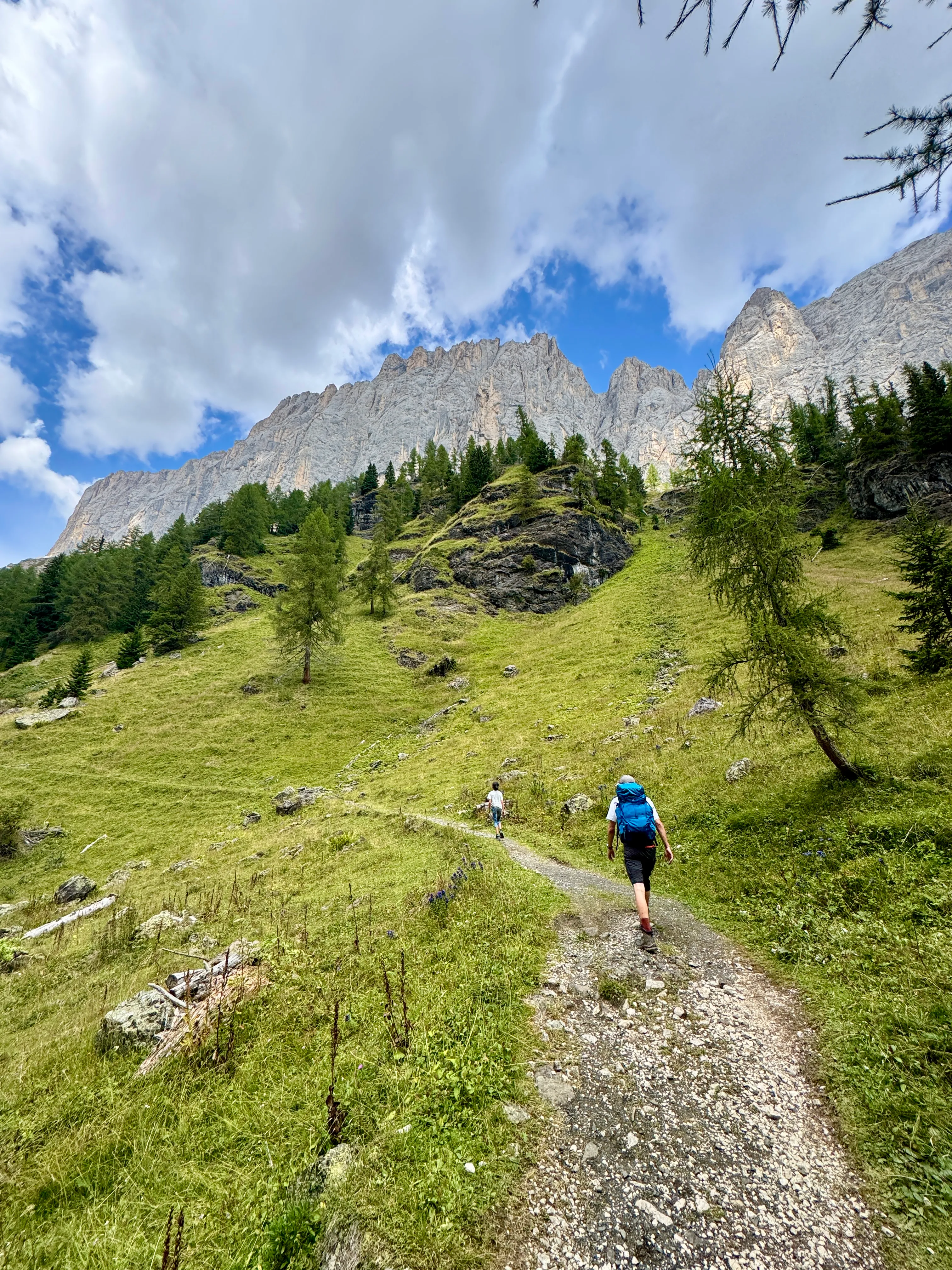
Because there are two ways up. There’s the wide, gravelled path that winds gently through the valley, perfectly pleasant and scenic. And then there’s the steep, wooded, off-road option — shorter in distance but significantly harder, scrambling over rocks and tree roots through dense forest.
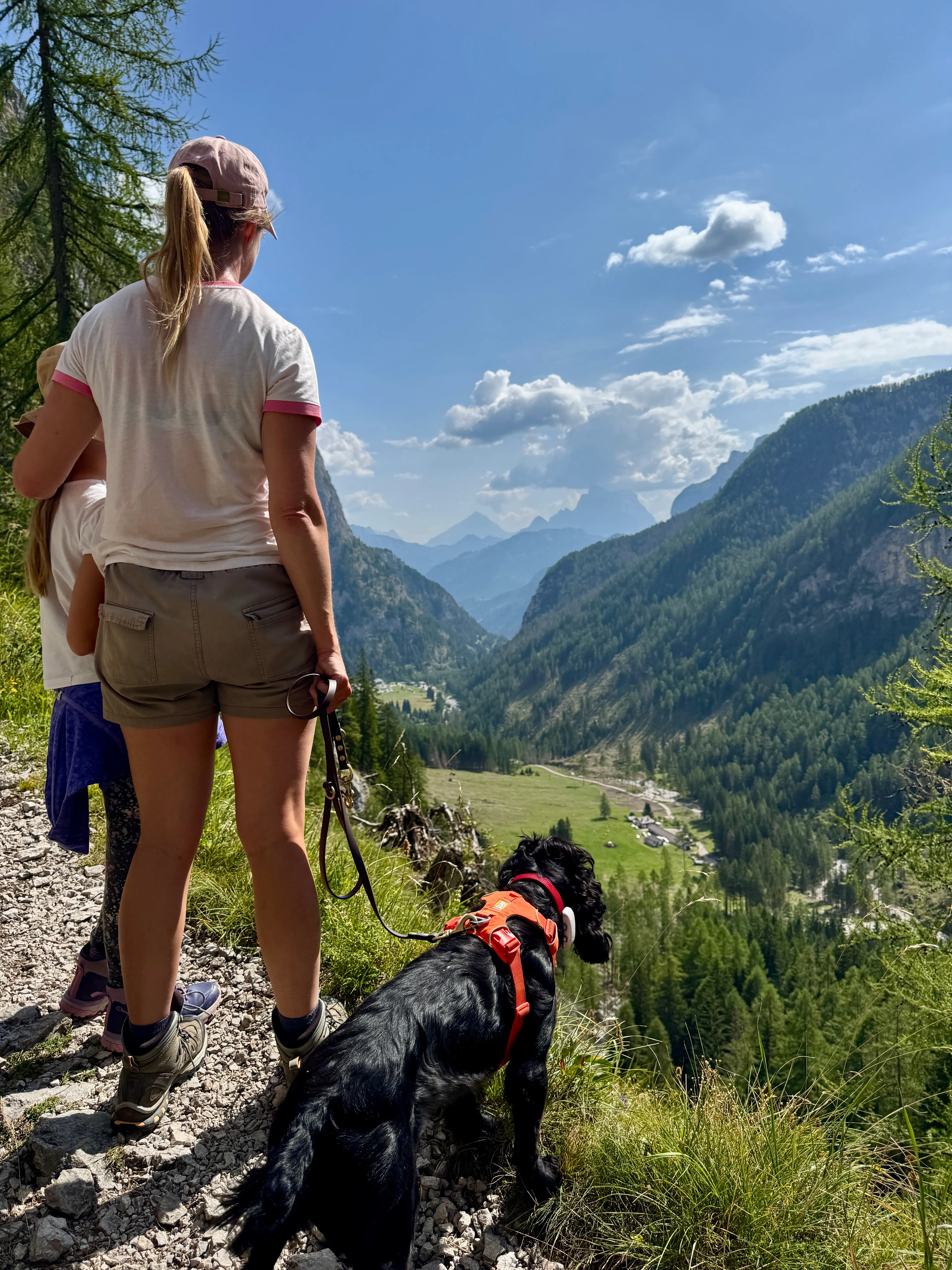
We are most definitely an off-road kind of family. Fred, our black working cocker spaniel, led the way up the steep stuff without a backward glance, and my daughter — our little warrior — was right behind him. If you’ve read my USA road trip blog you’ll know she earned that nickname on some pretty gnarly desert trails, and the Dolomites were no different.
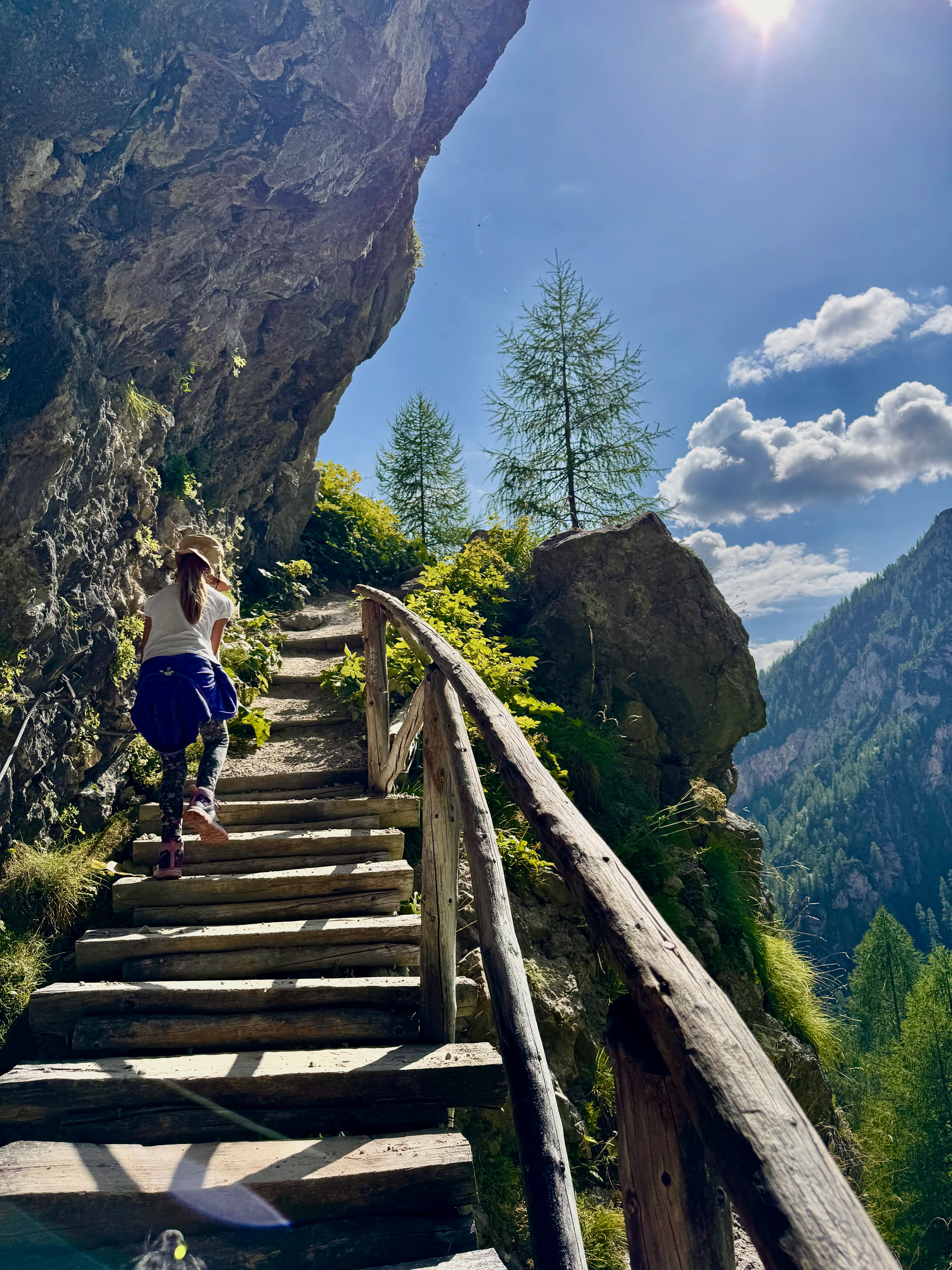 We climbed over fallen trees, stopped to watch waterfalls crashing down the mountainside and into the valley below, hauled ourselves up by tree roots and paused more than once to take in the views opening up around us. We eventually rejoined the main path and encountered our first humans since setting off. If you’re spotting a theme running through my blogs, you’ll know we love finding those moments where it’s just us and Mother Nature. Even when they’re fleeting, they’re the ones that stick with you.
Once the climb was done, the terrain opened out into a wide green meadow with the towering grey limestone peaks that are so unmistakably Dolomite rising up on all sides. Not far ahead sat our rest stop — Rifugio Malga Ombretta. There’s a rather famous homemade fruit and yoghurt bowl here that is exactly what you need to refuel for the walk ahead, plus a much-needed toilet stop after all that scrambling.
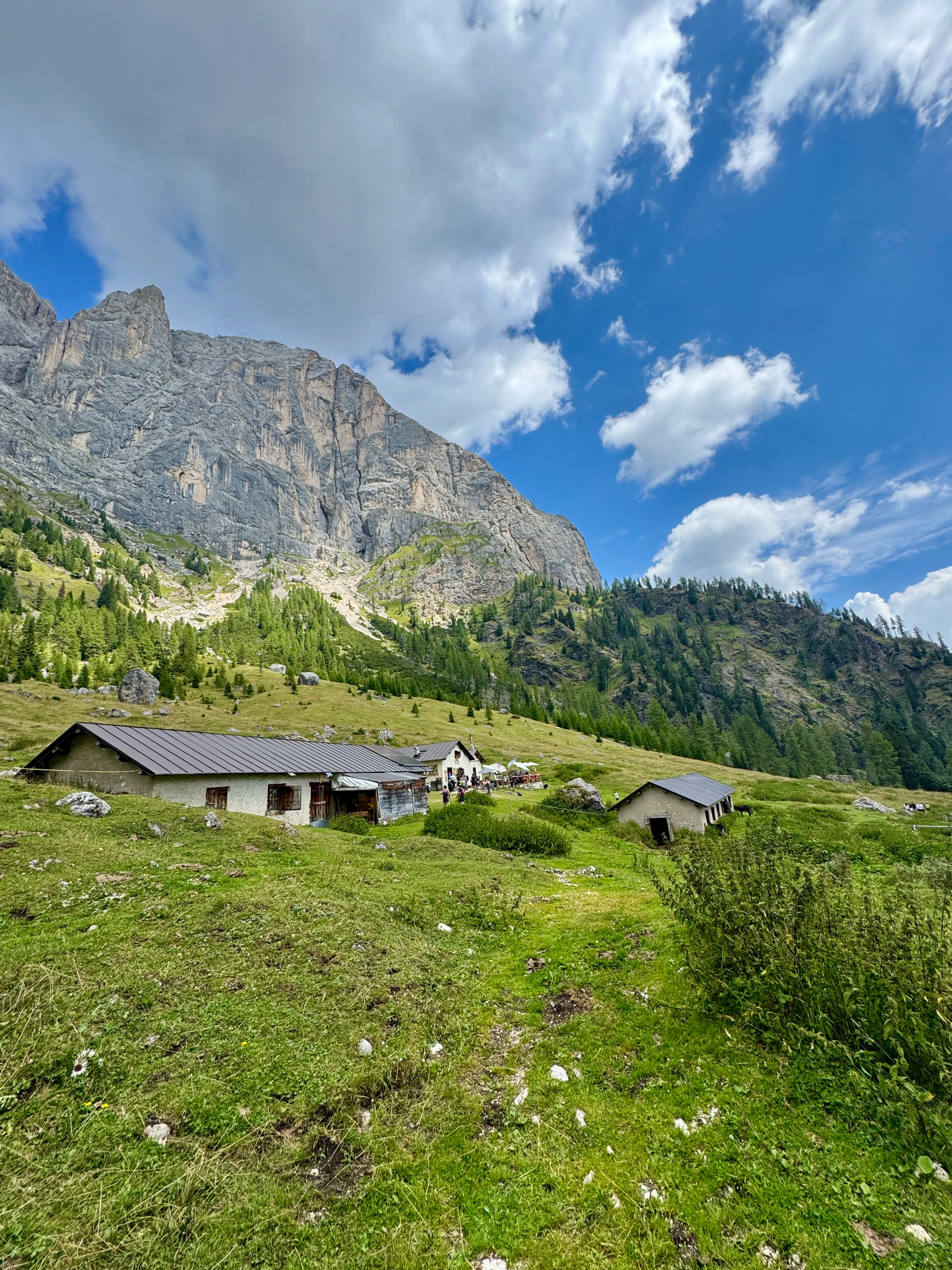
From Malga Ombretta you can either head back down or carry on to Rifugio Falier. Of course we carried on. The path hugs the mountainside and crosses a dried-up riverbed strewn with rocks before bringing you out at Rifugio Falier itself — perched high up with magnificent views out across the valley below. We stopped here for a snack and a drink, taking in the panorama before pressing on.
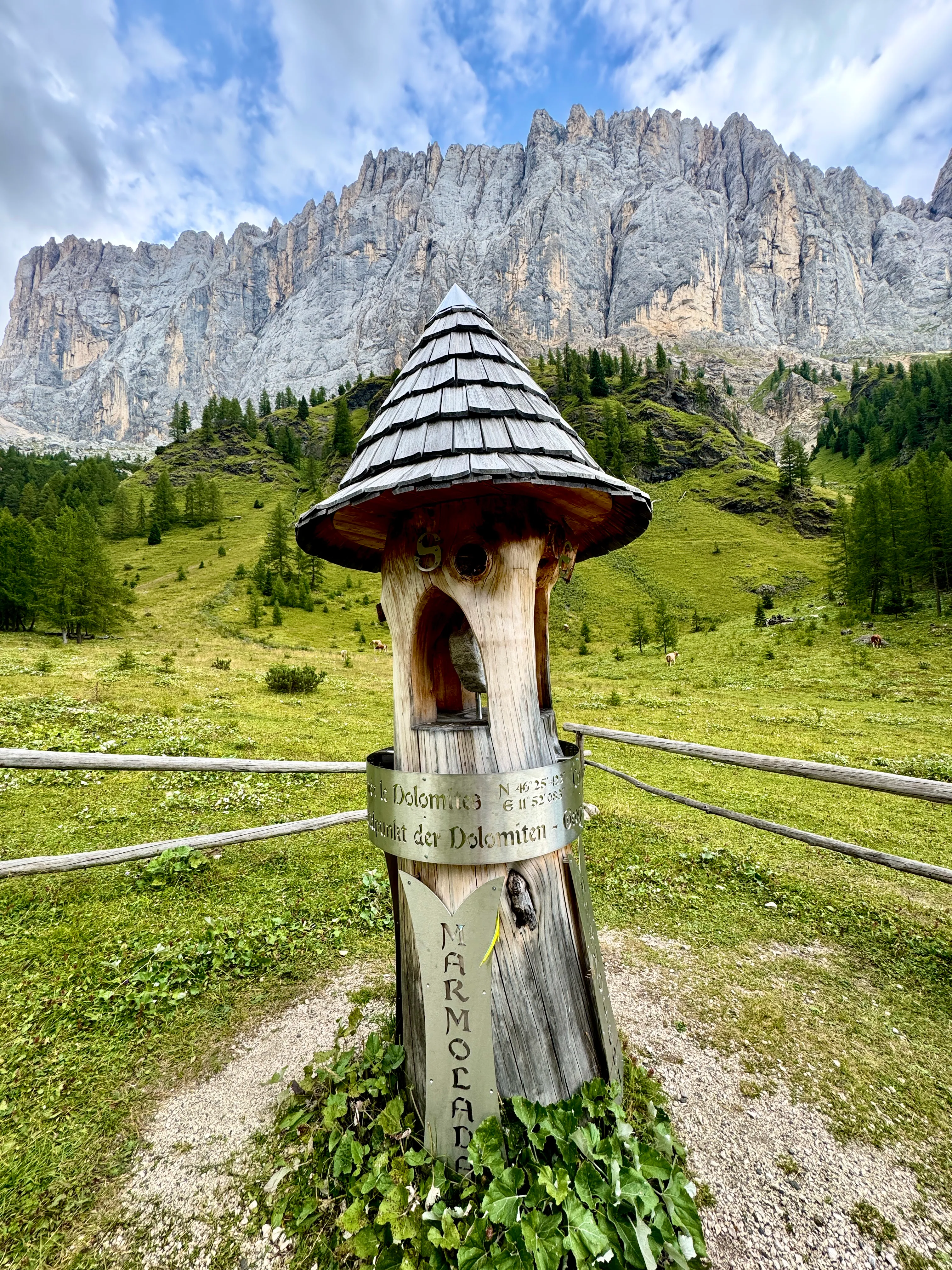
From there the trail drops down to a grassy plain, where we reached a stone monument marking the official geographical centre of the Dolomites — a wooden totem with a stone heart inside it, right in the middle of this vast, silent landscape.
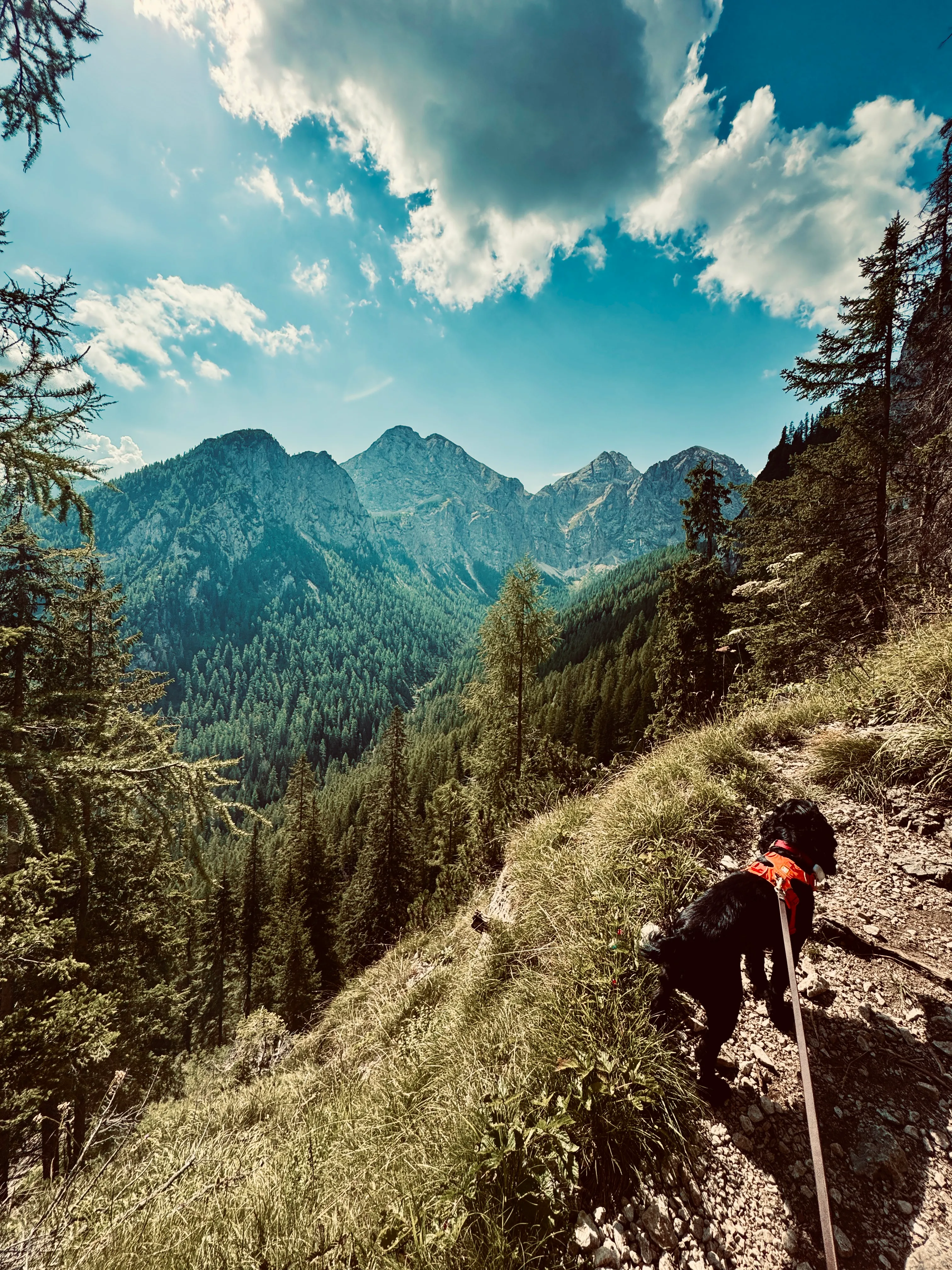
We took the easier path back down, which gave us slightly different viewpoints across the valley and mountains. Worth doing the loop rather than retracing your steps if you have the energy.
Is This Hike Suitable for Children and Dogs?
This is a brilliant family hike, but I’ll be honest — it’s one for children who actually enjoy hiking rather than those who need carrying or bribing with snacks every ten minutes. Our two managed it brilliantly, and Fred absolutely loved every second. Just keep an eye out for cattle on the higher meadows and pop your dog on the lead if you spot any cows. The off-road route adds a genuine sense of adventure that kept the kids engaged far more than a gravel path would have done.
Quick reference for the Rifugio Falier hike:
- Trail: CAI Path 610 from Malga Ciapela
- Distance: Approximately 12.6km
- Elevation gain: Around 876 metres
- Highest point: 2,074 metres, at Rifugio Falier
- Time: Allow 6 to 6.5 hours (around 5.5 hours at an average pace)
- Difficulty: Moderate (main path) to challenging (off-road forest route)
- Shorter option: Turning back at Malga Ombretta makes it around 10.5km with 585 metres of gain
- Dog-friendly: Yes — Fred managed it without any trouble, but he’s a fit and agile working cocker. Judge it depending on your dog
- Facilities: Rifugio Malga Ombretta and Rifugio Falier both serve food and have toilets
Off-Trail Hiking Near Malga Ciapela: The Best Walks Don’t Always Have a Name
Another day, another trail — except this one doesn’t seem to have an official name, which is partly why I loved it. We ventured up an uneven path full of rocks and tree roots from the campsite and just kept going. You know when you say to yourself “let’s just see what’s round the next bend,” or “just a tiny bit further,” and it turns into full-blown mission creep? Those tend to be the best walks because you’ve no idea what you’re heading towards.
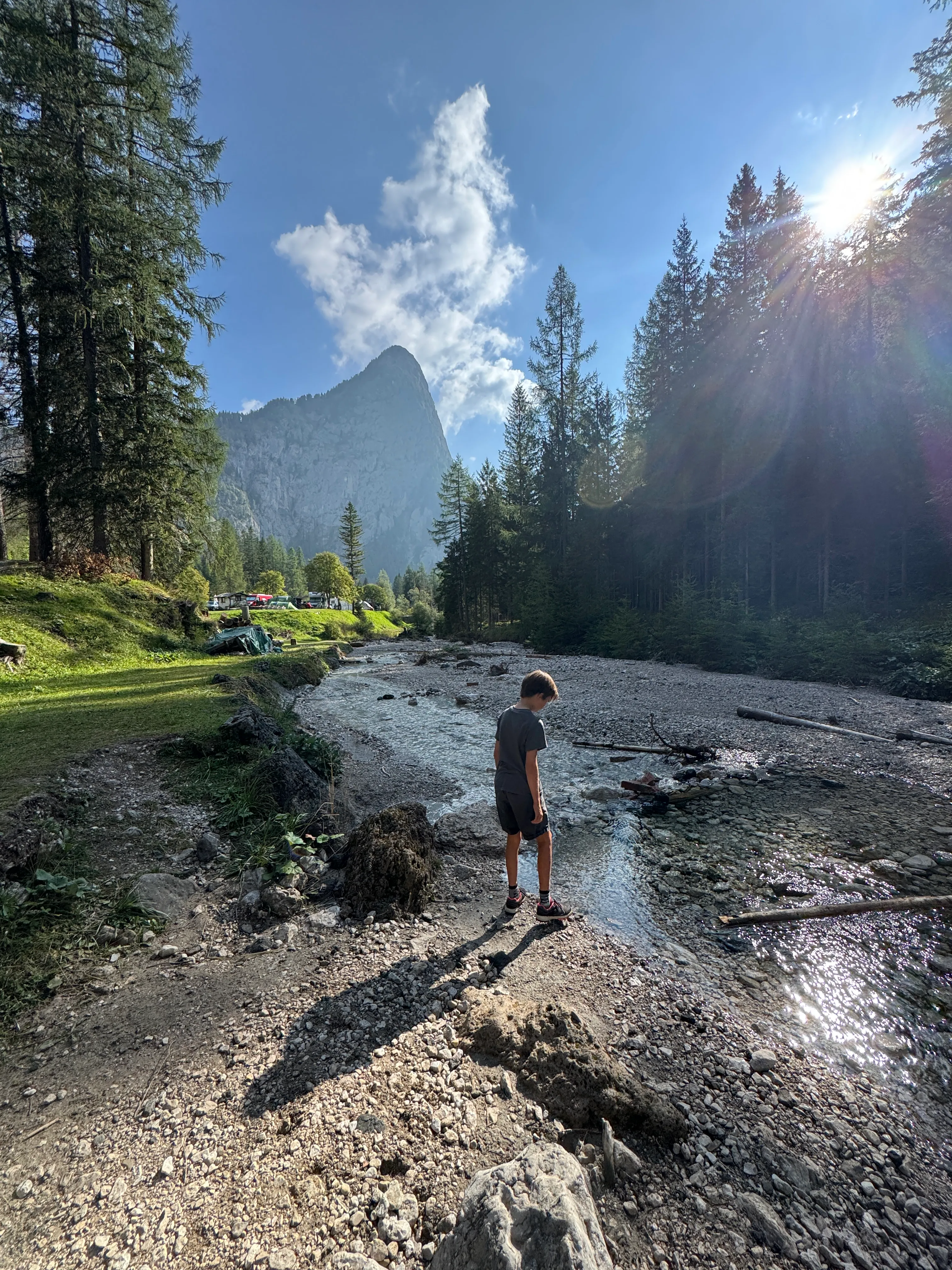
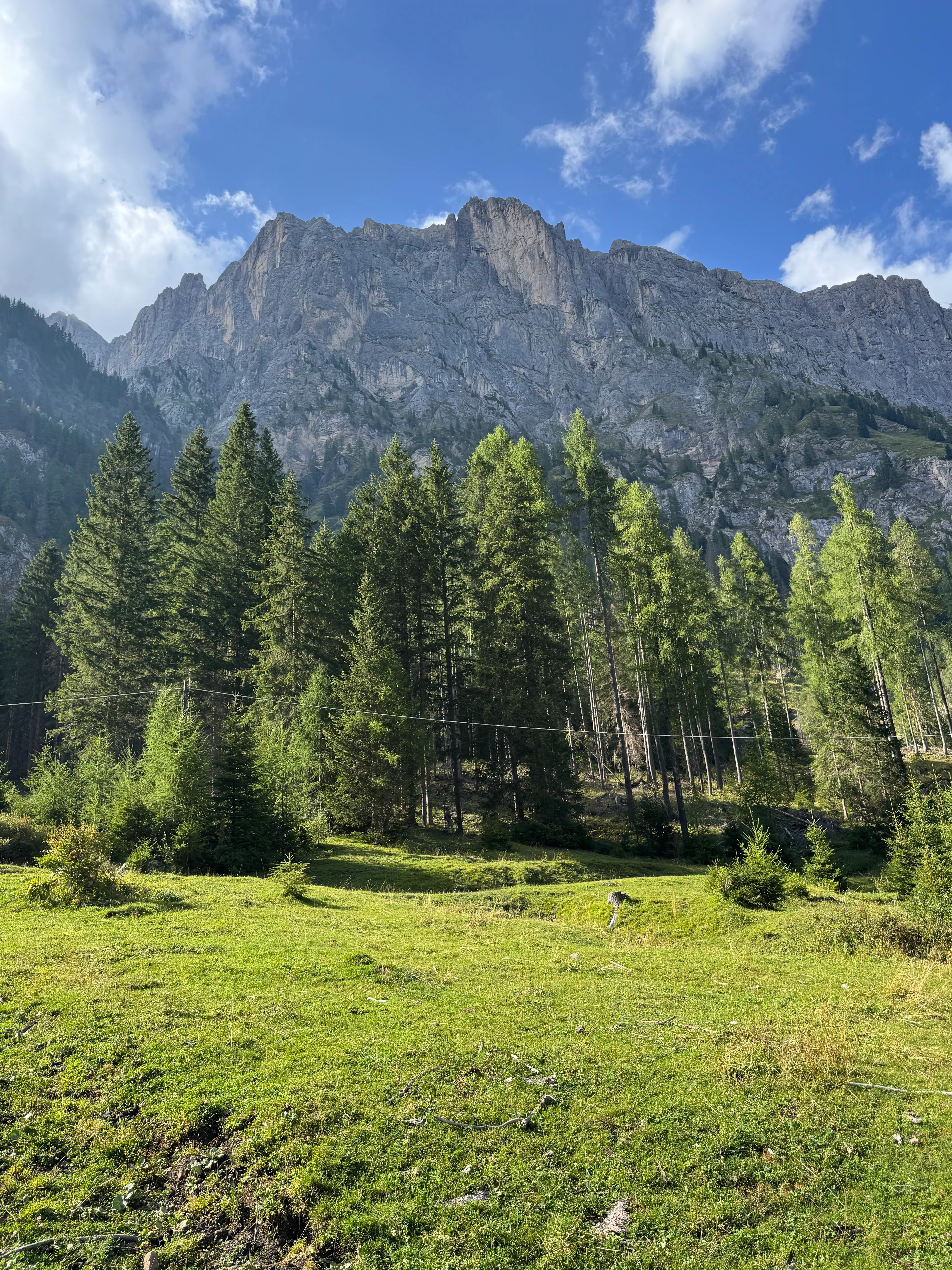 This one rewarded us with an opening in the forest — a grassy clearing with mountains surrounding us on all sides, not a single other person in sight. A crystal-clear stream gave Fred a chance to cool off and have a drink while the rest of us skipped across stepping stones and generally pretended we were the first people ever to find this place.
It’s hikes like this that make you feel like you’re properly exploring, not just following the crowd on an Instagram hotspot trail. No markers, no crowds, just mountains and silence. If you’re staying at the campsite, ask the staff about the forest trails heading uphill behind the site — they’ll know the ones I mean.
Marmolada Cable Car to Punta Rocca: The Queen of the Dolomites
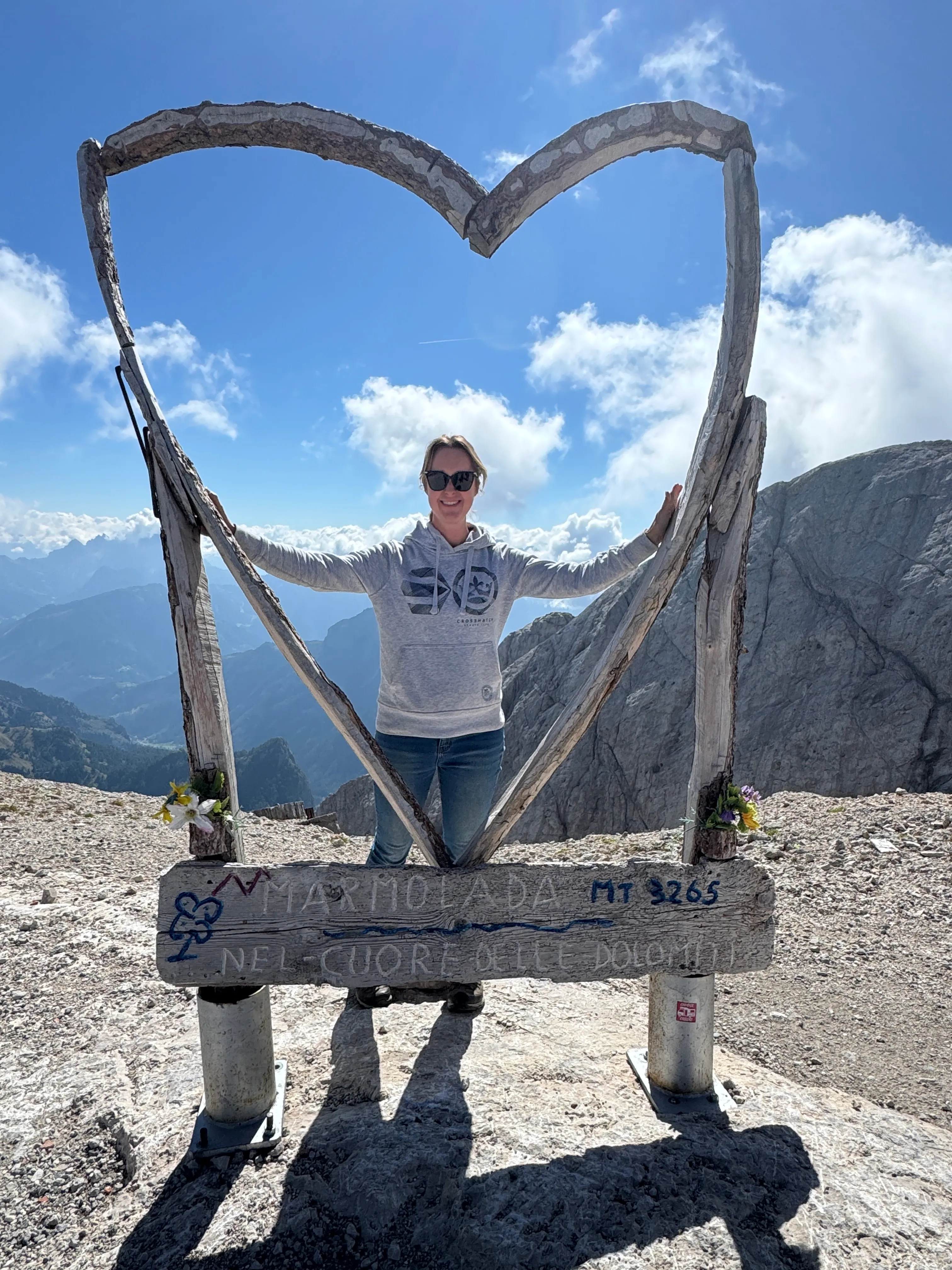
You cannot stay at the foot of the highest peak in the Dolomites and not go up it. Marmolada stands at 3,343 metres and the “Move to the Top” cable car takes you from Malga Ciapela at 1,450 metres to Punta Rocca at 3,265 metres in about twelve minutes, riding three successive cable cars with changes at Coston d’Antermoja and Serauta.
Cable Car Prices (Summer 2026)
A round-trip ticket from Malga Ciapela to Punta Rocca costs €38 per adult and €22 for teenagers (under 16). Children under six travel free. For our family of four, the total came to around €120 — roughly £100 depending on the exchange rate. Compare that to Swiss cable cars where you’d comfortably pay double or triple for a similar experience, and it feels like an absolute bargain.
The first cable car runs at 09:00 and the last descent from Punta Rocca is at 16:30. You can buy tickets at the base station or book online in advance through the Funivie Marmolada website.
Taking Fred (or Your Dog) Up Marmolada
We did this trip in two shifts rather than all going together. Fred wasn’t entirely comfortable at altitude the last time we took him up this high, and Italian public transport requires dogs to wear a muzzle — something we haven’t practised enough with to make it a relaxing experience for him. So the girls went up in the morning, the boys in the afternoon, and Fred spent both sessions happily snuffling around the woods with whoever had drawn the short straw of staying behind. He was completely oblivious and perfectly content.
If you are bringing your dog, they are allowed on the cable car but officially need to wear a muzzle. The ticket office confirmed this rule, though enforcement seemed fairly relaxed — we saw a couple of dogs riding up without muzzles. That’s your call to make, but I’d suggest having one with you just in case.
What It’s Actually Like at the Top
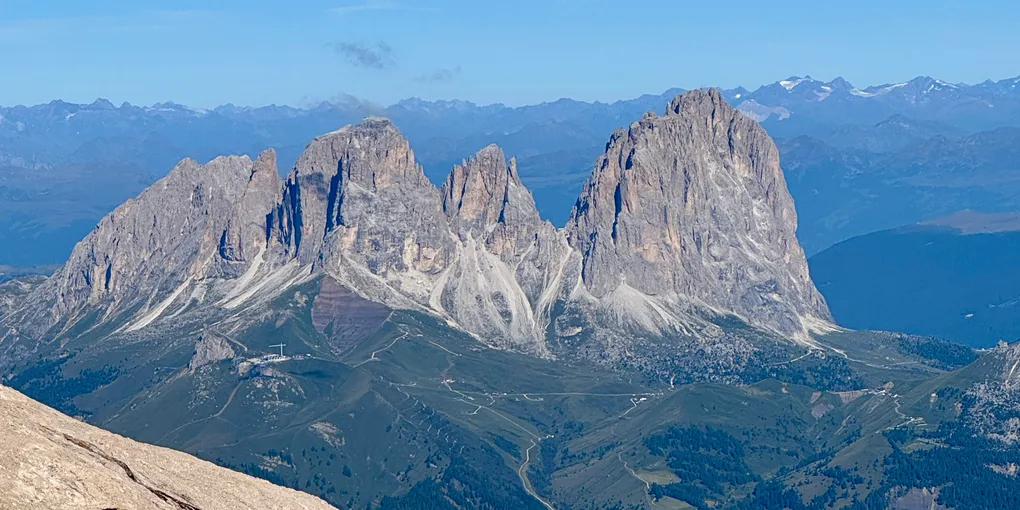
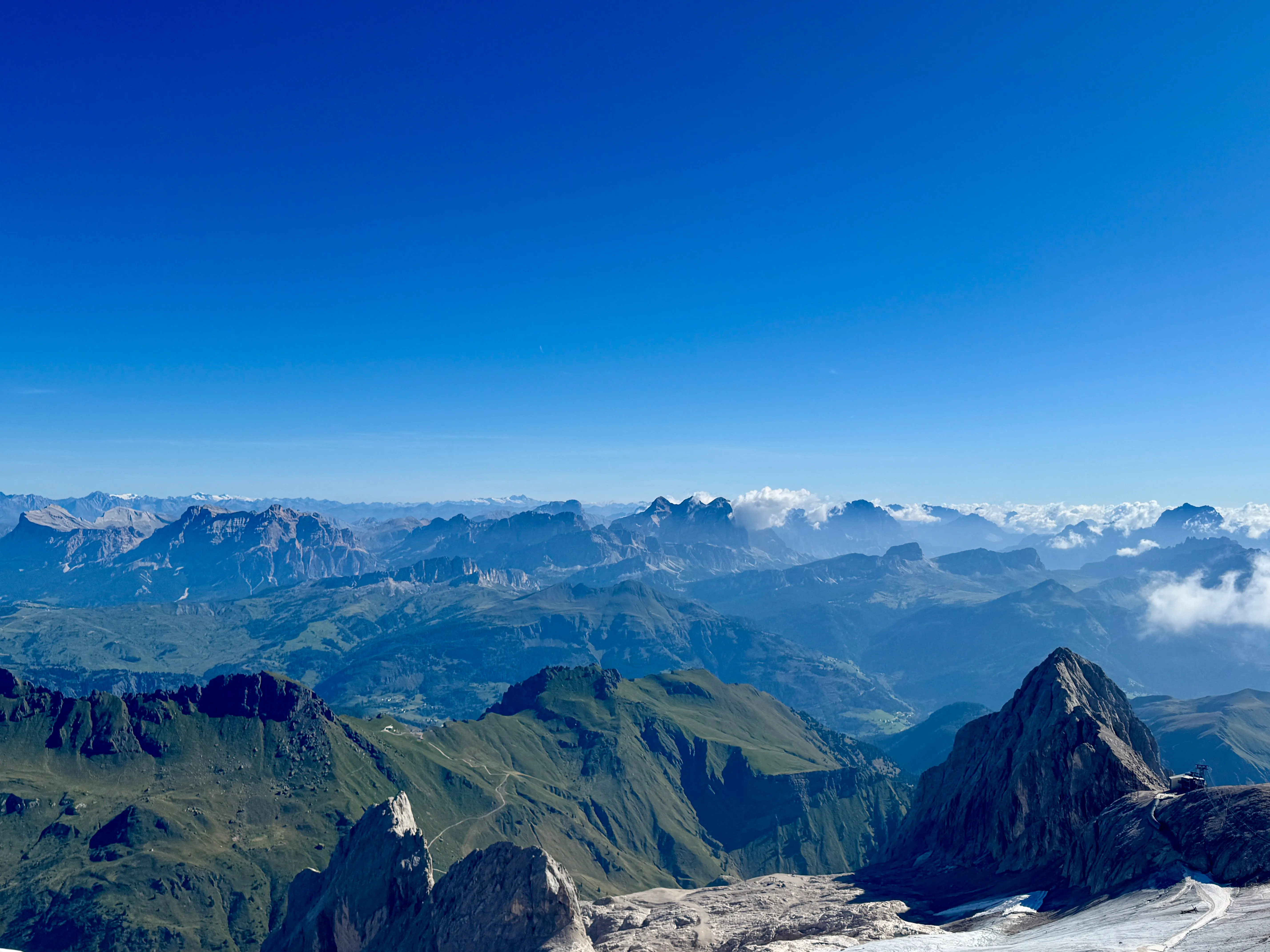
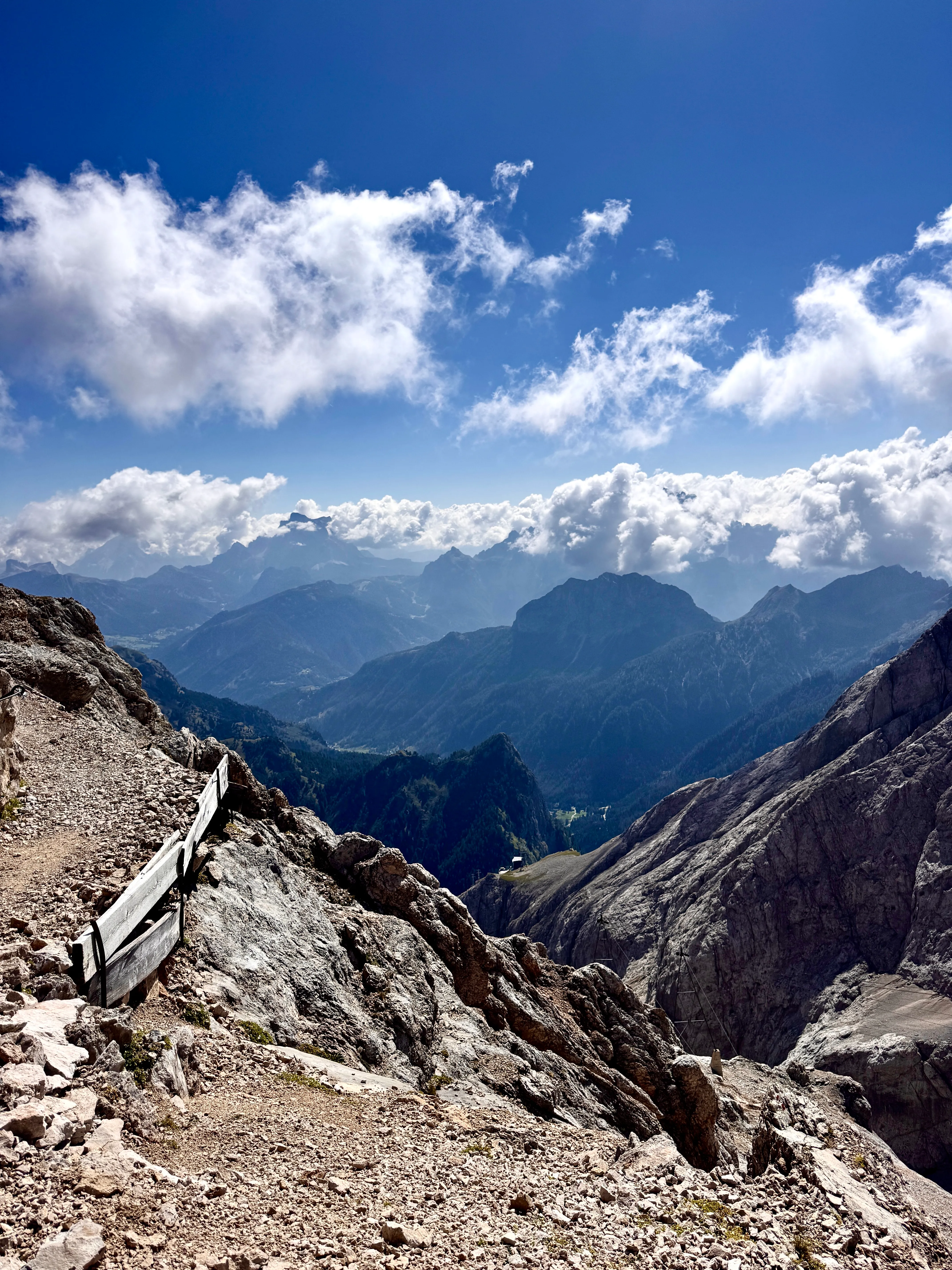 The word that kept coming to mind was immense. Standing on the panoramic terrace at Punta Rocca you get a full 360-degree sweep of the Dolomites — the Sella Group, Sassolungo, Civetta, Pelmo, and dozens more peaks stretching out in every direction under enormous skies. Nothing makes you feel more alive than standing on top of a mountain like that.
You can walk on the glacier itself, although it’s largely covered with protective tarpaulin now. The glacier is around 170 years old and current projections suggest it will have disappeared entirely by 2040, so there’s a genuine poignancy to seeing it. We managed to hop off the side of the walkway and my daughter built a little glacier man out of the remaining ice, which felt like a small act of defiance against the inevitable.
What struck me most was the refreshingly relaxed attitude to safety compared to France or Switzerland. Once you stepped out of the cable car station, you could wander pretty much wherever you wanted across the mountaintop without barriers or fences. There were some genuinely brilliant walks through old World War I tunnels and along fairly precarious paths carved into the rock. Had I not had my ten-year-old daughter with me I’d have explored further, but motherly instinct kicked in and we played it safe. We did, however, watch other people scrambling up to some frankly terrifying spots with apparent nonchalance.
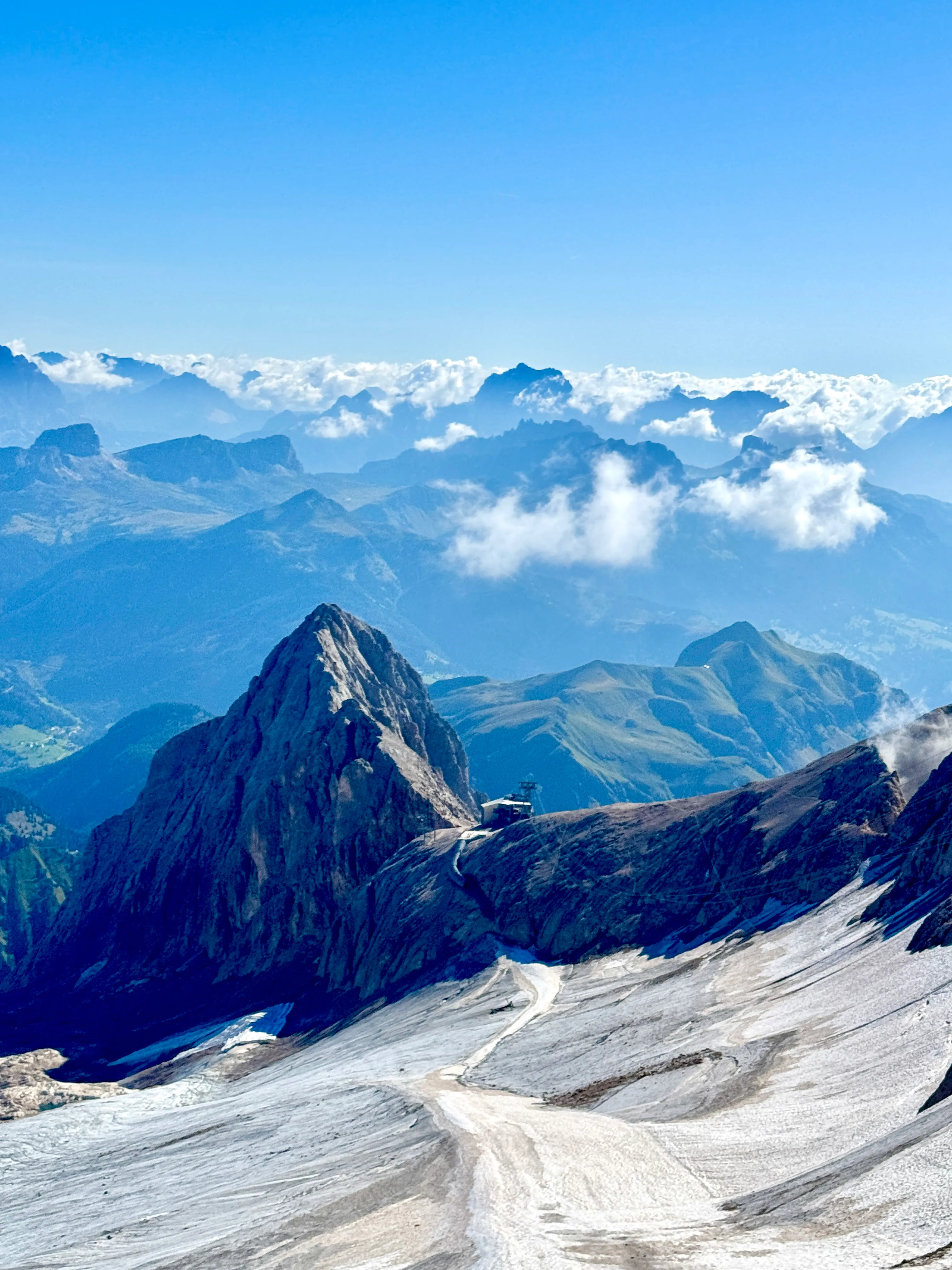
At the Serauta station (the middle stop) there’s also a World War I museum and the remains of a fortified position used by Italian soldiers from 1916. The museum entrance is included in your cable car ticket, and it’s a sobering and fascinating diversion — these soldiers fought in conditions that are hard to comprehend even when you’re standing in the exact spot they defended.
We had coffee and cake in the café at one of the stations on the way down, overlooking views that would cost you a fortune to enjoy anywhere in Switzerland. A half-day trip — morning or afternoon — is plenty of time to take it all in.
Where to Eat Near Malga Ciapela
I’ll be upfront here: Malga Ciapela is not the place to rock up expecting a strip of restaurants to choose from. The village is tiny and dining options are thin on the ground. We did a proper food shop on the way in and were glad of it — we bring our own little barbecue with us when we camp, and we ate well from our own provisions most evenings.
The restaurant at the campsite does advertise pizza, but it’s more of a snack-bar portion than a proper meal. What they do brilliantly, though, is the apple strudel. I’m not exaggerating when I say it was one of the best things I ate on the entire trip — proper homemade strudel with that crisp, flaky pastry and warm spiced apple filling. Worth a visit just for that.
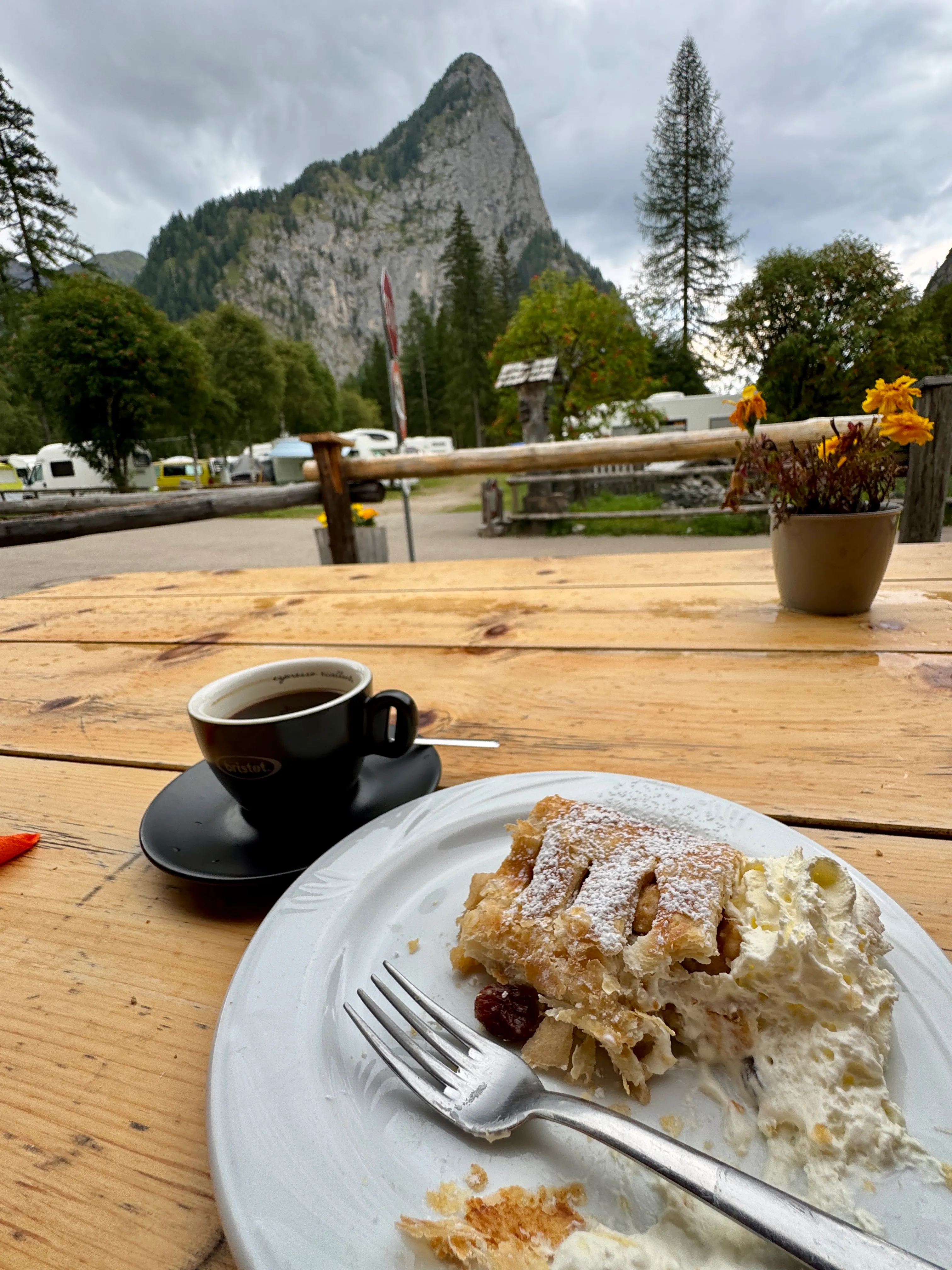
For a proper sit-down meal, you’ll likely need to drive to one of the larger nearby towns like Alleghe or Rocca Pietore. It’s not a long drive, but worth factoring in if you’re planning your evenings.
My advice: come self-catered with a well-stocked cool box and treat the campsite strudel as your daily reward.
Where to Stay Near Malga Ciapela and Marmolada
Camping
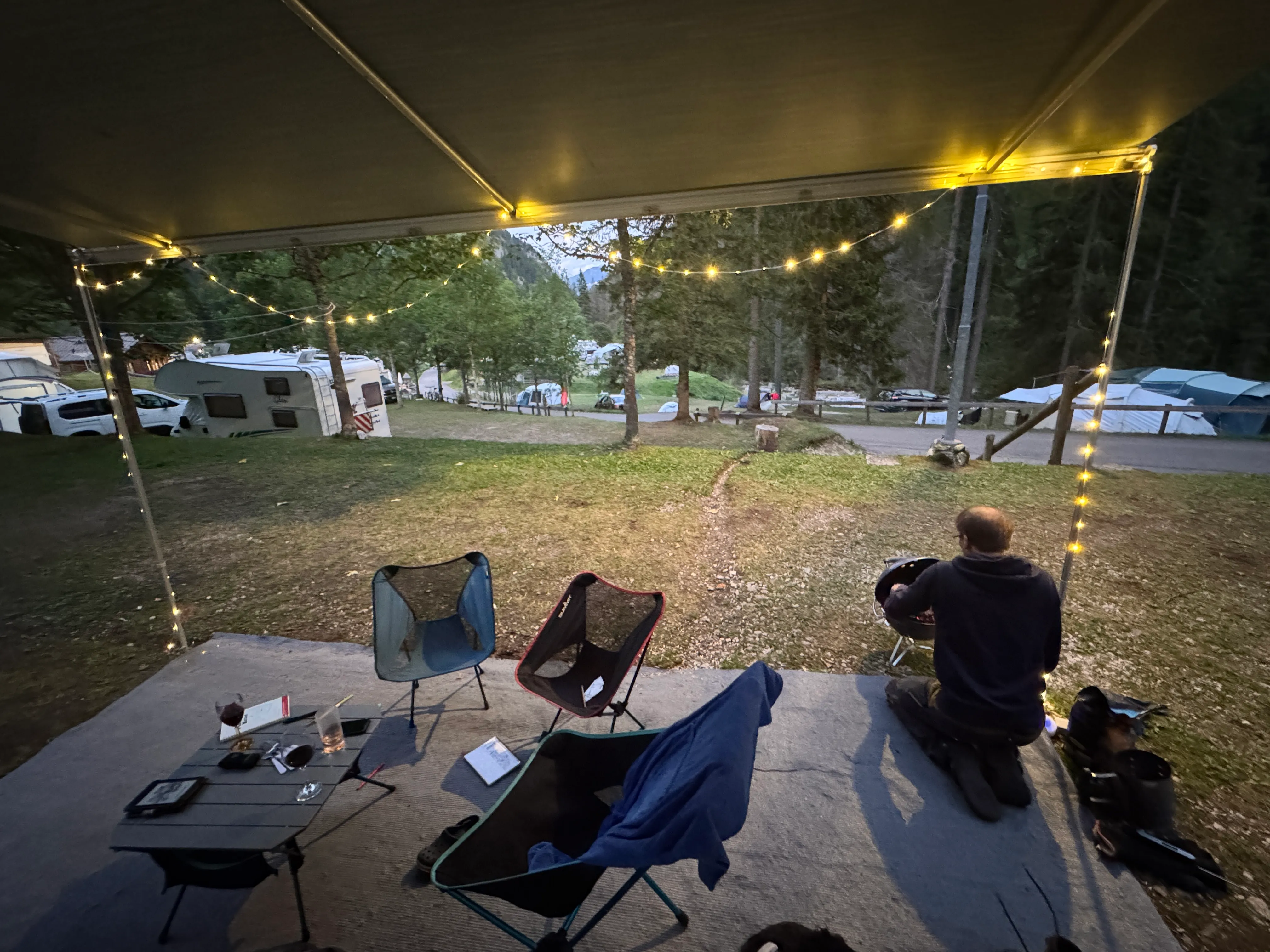
Camping Marmolada, Malga Ciapela is where we stayed and I’d highly recommend it. Shaded pine forest pitches, hiking trails from the doorstep, that strudel, and a five-minute walk to the Marmolada cable car. It was deservedly fully booked when we were there, so reserve your pitch well in advance if you’re visiting in peak summer.
Hotels and Guesthouses
If camping isn’t your thing, there are a handful of options right in Malga Ciapela and a wider selection in the surrounding area:
Hotel Principe Marmolada is the most established option in the village itself, sitting just a couple of hundred metres from the cable car base station. It’s a three-star family-run hotel with a restaurant, spa facilities, and mountain views. Rooms start from around €116 per night and they’re well-reviewed for food and location.
Hotel Tyrolia is even closer to the cable car — practically on its doorstep — and gets consistently strong reviews for its atmosphere, food, and welcoming hosts. It’s a smaller, cosier option that feels properly alpine.
Albergo Malga Ciapela offers a more traditional guesthouse experience with a garden and restaurant, about half a mile from the village centre. A good option if you want something quieter.
Baita Dovich, a little further out in Rocca Pietore (about ten minutes’ drive), is worth mentioning because it gets rave reviews and the restaurant is apparently exceptional — more than one reviewer has compared it to Michelin-level dining.
For a lakeside base with a short drive to Marmolada, Hotel La Montanina in Alleghe sits beside the beautiful Lago di Alleghe and offers a lovely contrast to the mountain intensity of Malga Ciapela.
Other Things to Do Near Malga Ciapela
If you have an extra day, the Serrai di Sottoguda gorge is well worth a visit. It’s a dramatic narrow canyon carved by the Pettorina stream, connecting the village of Sottoguda to Malga Ciapela, with towering rock walls, waterfalls, and a well-maintained path running through it. It’s an easy walk suitable for all ages and offers a striking change of scenery from the high mountain trails. Unfortunately this route was closed off when we were there due to storm damage the year before.
How to Get to Malga Ciapela
Malga Ciapela is in the Belluno province of Veneto, on the southern side of the Marmolada massif. You’ll need a car — public transport options exist but they’re limited and involve multiple changes.
The closest major airports are Venice Marco Polo (around two and a half hours’ drive), Verona (about two and a half hours), and Innsbruck across the Austrian border (roughly two hours). We drove down through the Alps which is an experience in itself — the approach through the Dolomite passes is stunning.
A word on driving times, though: mountain roads take longer than you think. Steep gradients, tight switchbacks and single-lane sections all slow you down, and if you’re in a motorhome — as we were — you can add at least a third on top of whatever Google Maps tells you. Don’t plan a tight arrival; give yourself plenty of margin and enjoy the drive rather than stressing about it.
Once you’re there, the village is tiny and everything is within walking distance. The cable car base station is a five-minute walk from the campsite, and the hiking trails start from the doorstep. You won’t need the car again until you leave — unless you fancy a restaurant in Alleghe or Rocca Pietore.
Would I Go Back?
Absolutely. Malga Ciapela gave us some of the best hiking we’ve done anywhere — proper, unspoilt trails where you can walk for hours without seeing another soul, and one of the most spectacular cable car experiences in the Alps at a fraction of Swiss prices. The Dolomites have a quality of light and a scale that’s completely different to anything I’ve encountered in the western Alps, and I’ve barely scratched the surface of what’s here.
I’d return to this valley in a heartbeat, but I’d also want to explore further into the Dolomites next time. There’s a lifetime of walking in these mountains.
Have you visited Malga Ciapela or hiked in the Marmolada area? I’d love to hear about your experience — get in touch.
Planning a trip to the Dolomites? Get in touch for a chat — with 27 years in the travel industry, I can help you put together the perfect itinerary.